
Faculty of Sciences undergraduate course programmes
Introduction
The aim of the undergraduate courses is to enrich and enhance the quality and level of university education for students, while fostering their critical thinking. Generally, these courses are designed using teaching methods that differ from those of undergraduate and graduate programmes at universities: assuming the acquisition of core knowledge and skills through students' university studies, the Scuola can focus its teaching on in-depth exploration of themes and methodologies.
The distinctive feature of the educational model at the Scuola Normale is the integration of teaching and research, which forms the backbone of the academic pathway. Student life involves constant interaction both with senior peers and PhD students and with their lecturers. College life encourages the continuous exchange of ideas and insights, embodying the Scuolaís vision as a large laboratory of ideas.
Students enrolled at the Normale must attend courses simultaneously at both the university they are enrolled in (University of Pisa or University of Florence) and the Normale. These include lectures, seminars, lab exercises and study periods, internships and placements in highly qualified institutions, along with other activities designed to enrich their education.
Foreign language courses are also offered, promoting the ability to navigate scientific literature and strengthening the communication skills needed to engage with overseas students present thanks to exchange agreements and with visiting professors invited to give seminars and lectures.
Obviously, the development of these skills varies across the three academic structures according to the specific characteristics of each subject.
In addition to access to the library, laboratories and computing facilities of the Normale, students are provided with free accommodation in the colleges, meals, reimbursement of university tuition fees at the University of Pisa or the University of Florence, and funding for mobility to other Italian and international institutions for summer schools, internships and other educational activities.
Students who fulfil the academic obligations set by the internal regulations regarding the first three years attain the first-level degree diploma, while students who enter the Normale at the fourth year and fulfil the academic requirements of the two-year graduate programme are awarded the second-level degree diploma, equivalent to a Level II Master's degree.
Students who enter at the first year and complete the full five-year programme attain the Diploma di licenza, also equivalent to a Level II Master's degree.
Undergraduate Courses of the Faculty of Sciences
In the Faculty of Sciences, the courses offered in the early years systematically present more advanced content than standard university courses. This is due to the intense focus on solving exercisesóboth during lectures and independentlyóand to a higher degree of personal involvement, partly fostered by tutoring activities. The Master's-level courses are more specialized and single-subject in nature; they typically serve as an introduction to research and are frequently attended by both Masterís and Ph.D. students, promoting interaction and research integration between the two groups.
Biological Sciences
The Undergraduate Course in Biological Sciences at the Scuola Normale Superiore consists of a first three-year cycle corresponding to the Bachelorís degree and a subsequent two-year cycle corresponding to the Masterís degree. It is integrated with the Biological Sciences degree programmes at the University of Pisa. The entire programme stands out for its strong interdisciplinary and quantitative approach, combining a solid foundation in the basics of biology with the study of advanced analytical tools stemming from mathematics, physics, bioinformatics and artificial intelligence.
During the first three years, core life science topics such as molecular cell biology and neurophysiology are explored at a higher level of depth than in standard university programmes. These are complemented by physics and mathematics courses designed to provide the analytical tools essential to understanding biological systems through quantitative models. Introductory courses in bioinformatics and artificial intelligence enable students to critically engage with the analysis of complex biological data. Two laboratory courses provide essential hands-on experience in cellular biology, molecular biology and physiology.
The second two-year cycle, corresponding to the Master's degree, includes advanced, specialized courses on complex biological systems and neuroscience topics such as neurophysiology, neurogenomics, stem cells, advanced bioinformatics and machine learning for life sciences, along with molecular biophysics and quantum physics applied to biology. Students prepare an interview based on a specialized research project ("Colloquio") to develop their analytical skills and independence in addressing an advanced scientific problem. This phase culminates in the writing of the Masterís thesis during the second year.
Overall, the Undergraduate Course in Biological Sciences aims to strengthen and expand academic preparation through a high-level, interdisciplinary education, stimulating the capacity for autonomous research and critical thinking. It is designed for motivated students intending to pursue PhD studies and careers in cutting-edge research in molecular biology and neuroscience.
Chemistry and Geology
The Undergraduate Course in Chemistry and Geology consists of a three-year Bachelor's level cycle followed by a two-year Master's level cycle. It is a programme within the Faculty of Sciences at the Scuola Normale Superiore, integrated and complementary to the corresponding degree programmes at the University of Pisa. Therefore, students of the Scuola are also concurrently enrolled in the University of Pisa (three-year course or Master's degree). Admission is to the first or fourth year via a competitive exam with written and oral tests in mathematics/physics and chemistry (for the first year) or in chemistry alone (for the fourth year).
The first three years, partially shared with the Mathematics and Physics programmes, are intended to provide students with a solid foundation in the quantitative natural sciences, along with in-depth courses in specific fields of chemistry, and in particular in physical chemistry and theoretical/computational chemistry. During this period, students are also introduced to the scientific research areas pursued by lecturers at the Scuola Normale Superiore.
In the subsequent two-year cycle, where course selection is more flexible, teaching and research are more tightly integrated. Advanced topics in various areas of chemistryómainly physical, theoretical and computational chemistryóare studied in depth. Students engage in individual research projects with groups and labs in their areas of interest. The programme concludes with a public defense of a research topic, upon which the diploma is awarded.
The Undergraduate Course in Chemistry and Geology prepares students for both PhD studies and highly qualified professional careers in industry or research institutions in Italy and abroad.
Physics
The Undergraduate Course in Physics, consisting of a three-year Bachelorís cycle and a two-year Masterís cycle, is part of the Faculty of Sciences at the Scuola Normale Superiore and is integrated with the corresponding degree programmes of the Physics Department at the University of Pisa. Admission is through a competitive exam with written and oral tests in mathematics and physics (for the first year) or in physics (for the fourth year).
The first three years, partially shared with the Mathematics and Chemistry programmes, are designed to provide students with a solid foundation in the quantitative natural sciences and to foster personal growth. Broad institutional courses are combined with an initial introduction to the research areas cultivated at the Scuola.
In the subsequent two years, in which students can choose from a more diverse and specialized set of courses, teaching and research become even more closely intertwined. Advanced topics are studied across various branches of physics: from condensed matter to quantum sciences and technologies, from experimental fundamental interactions to theoretical physics and from astrophysics to cosmology. Students also participate in individual research projects with research groups and laboratories on themes in which they are interested (in preparation for the so-called Colloqui, based on a kind of mini-thesis); at the end of the two years, they publicly defend a research topic to receive the diploma.
In addition to this educational course, students are also enrolled in the University of Pisa's Bachelor's and Masterís degree programmes in physics. Above all, they experience these intense years of study in close contact with each other and with their lecturers, engaging in a daily exchange of ideas and experiences.
The Undergraduate Course in Physics prepares students both for PhD studies and for highly qualified careers in research institutions or private industry, in Italy and abroad.
Mathematics and Computer Science
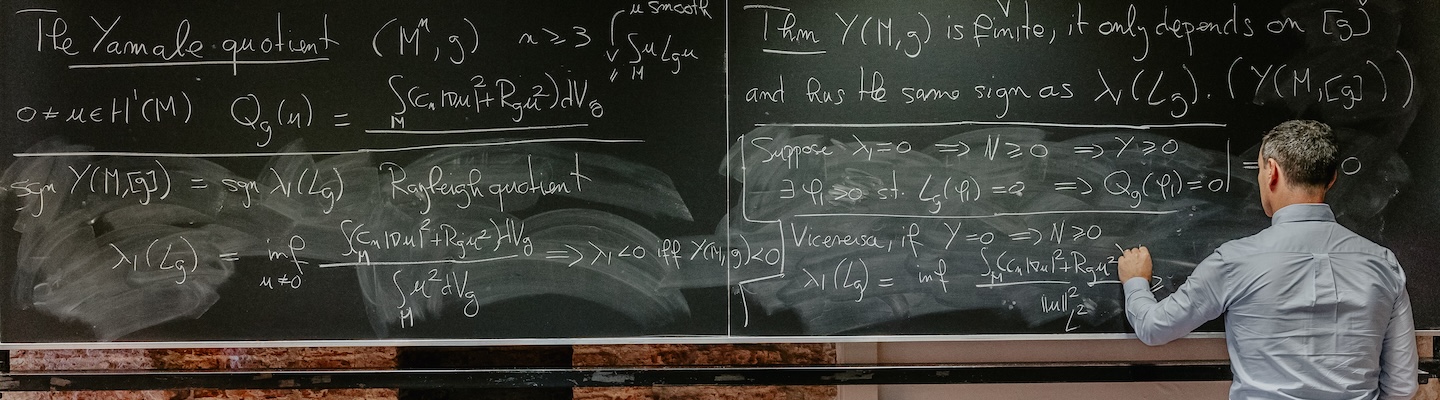
The Undergraduate Course in Mathematics and Computer Science at the Scuola Normale Superiore consists of a first three-year cycle corresponding to the Bachelorís degree and a second two-year cycle corresponding to the Masterís degree. It is integrated with the respective degree programmes in Mathematics and Computer Science at the University of Pisa.
The courses in the first three years, partly shared with the Physics programme, have a strong foundational focus. Some topics traditionally covered in university-level courses are studied more deeply and broadly, with the support of intensive problem-solving sessions. In the third year, students must complete both a Bachelor's thesis at the University of Pisa and a Colloquio, a research-based interview, for which they investigate an advanced topic under the guidance of a lecturer.
The two-year Masterís courses offer more specialized and student-selected courses, and are also attended by postgraduate and PhD students. These courses often serve as introductions to research in various fields of mathematics developed at the Scuola, such as Algebra and Geometry, Mathematical Analysis and Probability, Numerical Analysis, Mathematical Physics, Dynamical Systems Theory, Artificial Intelligence and applications in finance and economics. In the first year of the Masterís cycle, students prepare a second Colloquio or research-based interview, exploring an advanced topic in greater depth under the supervision of a lecturer; this is followed in the second year by the Masterís thesis.
Overall, the Undergraduate Course in Mathematics and Computer Science initially aims to reinforce studentsí university education through more advanced coursework and intensive exercises. It then encourages studentsóparticularly through the two Colloqui (research-based interviews) in the third and fourth yearsóto pursue more specialized studies in preparation for research or PhD programmes.