
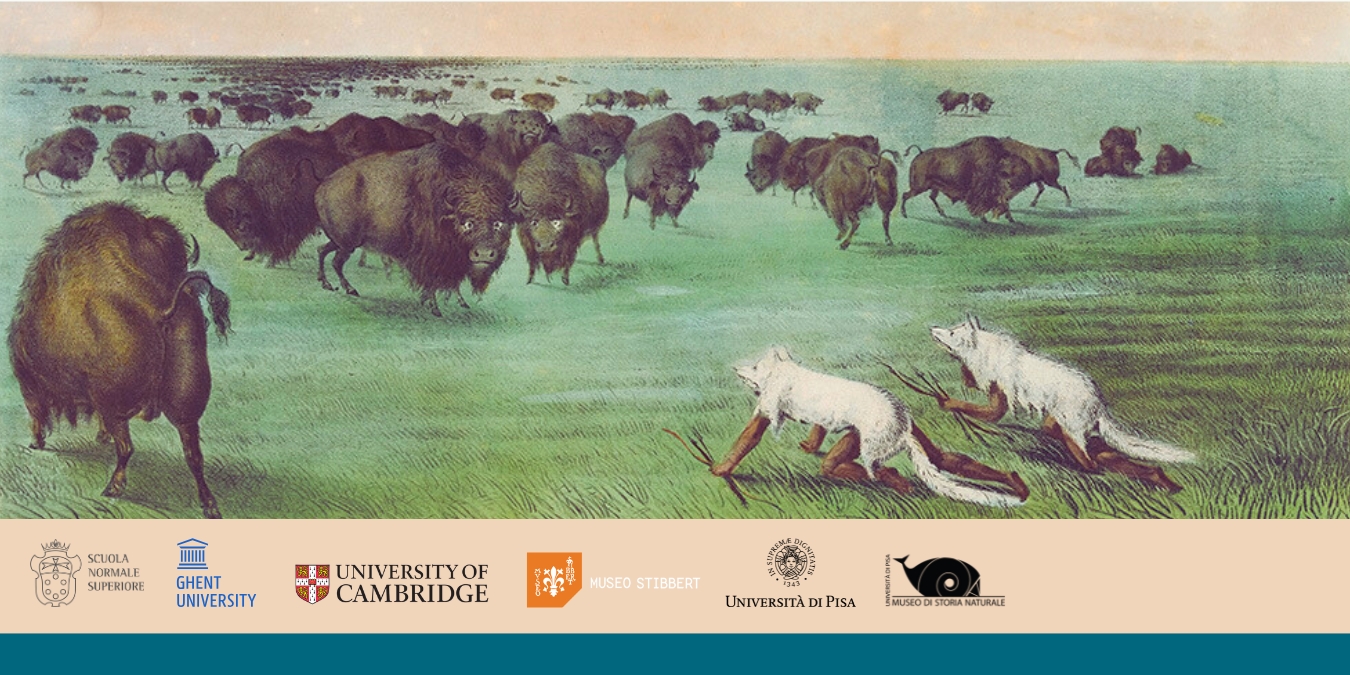
New Perspectives on Animal Camouflage and Human Image-Making
Camouflage is not the exclusive domain of animals. Humans also practice it, in hunting, war and fashion, social behaviour, and the arts. It is not restricted to artefacts; it also occurs in social behaviour, when people disguise their social status, desires, or motives behind appearances they judge to be more acceptable or effective. The shared domain of animal and human camouflage and mimicry raises many psychological, cultural, behavioural, and evolutionary questions about the relations between such animal and human behaviour, but it also offers new ways of thinking about the relations between human and other animals, the evolutionary origins of cognition, image-making, and empathy, and new departures for a dialogue between the humanities and life sciences. In this workshop we will bring together zoologists, cognitive scientists, as well as specialists of art, costume, gardens, the hunt, and the theatre, to discuss how camouflage and mimicry shape animal and human behaviour and artefacts, and how an understanding of this shared domain can help rethinking the relations between human and other animals. We hope that this workshop will also provide a major impulse to the rethinking of a radical gap between animals and humans that takes place in philosophy as well as in ethology for instance.
Program
Wednesday November 19 (Scuola Normale Superiore, Sala Azzurra)
18.00–18.15 Welcome
18.15–19.30
Lorenzo Bartalesi | Scuola Normale Superiore, Caroline van Eck | Cambridge University
Introduction to the workshop “New perspectives on animal camouflage and human image-making”
Bram Van Oostveldt | Ghent University, Zoë Vanderhaeghen | Ghent University, Niki Hadikoesoemo | Ghent University
Presentation of the project “The Prehistory of Camouflage and Mimicry”
Thursday November 20 (Natural History Museum, Pisa – Conference Room)
14.00–15.00
Leonida Fusani | Vienna University / Konrad Lorenz Institute of Ethology
Visual deception and sensory manipulation in sexual communication
15.00–16.00
Nicola Clayton, Victor Ajuwon, Willa Lane | Cambridge University,
The science of magic: insights into cephalopod behaviour and camouflage [online]
16.00–16.30
Coffee break
Lorenzo Bartalesi | Scuola Normale Superiore.
Aesthetic attention, deception and ways of seeing in animal masquerade: notes for a prehistory of human image-making
Friday November 21 (Stibbert Museum, Firenze – Conference Room)
14.00–15.00
Stijn Bussels | Leiden University, Bram Van Oostveldt | Ghent University
Between Seeing and Not-Seeing. Camouflage, the Sublime and the Grotesque.
15.00–16.00
Neal Spencer, Juliet Carey, Ladan Akbarna | Fitzwilliam Museum, Cambridge,
Displaying deception: objects and methods to create resilience
16.00–16.30
Coffee break
16.30–17.30
Pietro Conte | Università degli studi di Milano
As if I were you: Mimicking nonhuman perception through VR technologies
Saturday November 22 (Scuola Normale Superiore, Aula Contini)
09.30–10.30
Caroline van Eck | Cambridge University
Deception, Dissimulation and Design: Successful camouflage, failed masquerade and the emergence of Denkraum