
Late Neoliberalism and its discontent in the european peripheries and beyond
Italy
Late Neoliberalism and its discontent in the european peripheries and beyond
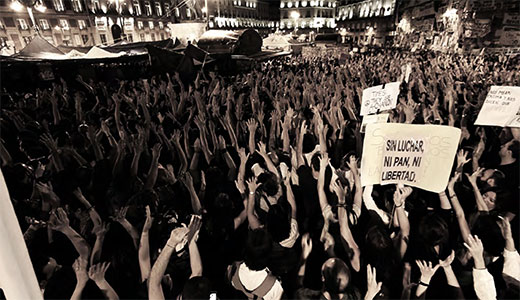
Social movements have long been considered as children of affluent times—or at least of times of opening opportunities. Already research on the labour movement expected strikes to develop when unemployment was low, or at least when economic crisis was accompanied by an opening of political opportunities (as, e.g., in the New Deal in the US). The protests against the Great Recession in the European periphery defy these expectations developing in moments of declining opportunities at both economic and political levels. Can social movement studies be nevertheless useful to understand these movements of troubled times? This conference aims at addressing this question, but specifying the need of bridging contentious politics with other fields, including political economy. In doing so, it will outline the types of crises movements had to react to as they unfolded at EU level. Second, it will discuss the type of political responses to the crisis, and their social and political consequences, setting the contextual political challenges for social movements in the great recession. All along, it will stress cross-time evolution and cross-national differences in the development of the crises, with particular attention to the European periphery—that is, the area most hit by the crisis but also where social movements against austerity have been more active, although in different forms. It will offer a dynamic view of protest in times of austerity, looking at it as relational, that is built upon interactions between different actors; constructed, as it is filtered through the social construction of the external reality; and emergent, as it develops from critical junctures, which reduce the power of structural constraints, increasing agency power.
First Session (9:30-11:00)
Introduction
Donatella Della Porta (Scuola Normale Superiore, COSMOS)Neoliberalism and its discontent: an I introduction
Rick Fantasia (Smith College)KEYNOTE, Austerity As A Way of Life
11:00-11:15 Coffee break
Second Session (11:15-12:45)
Late Neoliberalism and its discontent in Southern Europe
Eduardo Romanos and Markos Vogiatzoglou (COSMOS)Southern Europe’s Spring: Anti-austerity protest in Spain and Greece
Massimiliano Andretta and Tiago Fernandes (COSMOS)Late Neoliberalism and its discontent: Comparing Italy and Portugal
12:45-14:00 Lunch break
Third Session (14:00-15:00)
Late neoliberalism and its discontent in European Islands
Marcos Vogiatzoglou (COSMOS)At the edges of Europe: anti-austerity protest in Iceland and Cyprus
Frank O’connor (COSMOS)Crises and Movements in Ireland
Fourth Session (15:00-16:00)
Expanding the research to Eastern Europe
Chiara Milan (COSMOS)“Sow hunger, reap anger”: neoliberal privatization and new collective identities in Bosnia Herzegovina
Julia Rone (COSMOS)Left in Translation: The curious absence of an austerity narrative in the Bulgarian 2013 protests
16:00-16:15 break
Fifth Session (16:15-17:45)
Expanding the research beyond Europe
Kivanc Atak and Donatella Della Porta (COSMOS)Neoliberal urbanity and state coercion in the genesis of Gezi
Mariana Mendes (COSMOS)Brazil’s popular awakeningA journey through the hottest month of Brazil’s autumn
Juan Masullo (COSMOS)Making sense of “La Salida”Challenging Left-wing control in Venezuela
Sixth Session (17:45-18:45)
Maria Kousis (University of Crete)KEYNOTE, Contention, Solidarity, and Attributions of Responsibility in Eurozone’s periphery
Istituto di Scienze Umane e SocialiScuola Normale SuperioreConference Hall “l’Altana”Palazzo StrozziFLORENCEeventiculturali.firenze@sns.it
Admission will be allowed up to the maximum capacity of the conference hall
Locandina
Programma