
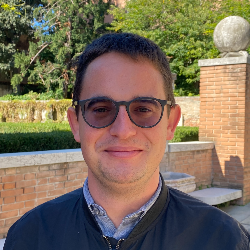
Federico Della Rossa
Research assignee
Lingua e letteratura greca (SSD: HELL-01/B)
Federico Della Rossa was born on 24th October 1997 in Udine, Italy, where he attended the Liceo Classico “Jacopo Stellini”, graduating cum laude.
In 2016, he was admitted to the Undergraduate course in Ancient History and Classical Philology at the Scuola Normale Superiore, Pisa.
He obtained his bachelor’s degree in Humanities at the Università di Pisa in 2019 (supervisor: Prof. Enrico Medda), cum laude.
In 2022, he earned his master’s degree in Classical Philology and Ancient History at the Università di Pisa (https://etd.adm.unipi.it/theses/available/etd-03092022-092928/; supervisors: Prof. Enrico Medda, Prof. Andrea Taddei), cum laude. Concurrently, he obtained his diploma di licenza at the Scuola Normale Superiore (supervisor: Prof. Luigi Battezzato), cum laude.
In 2023, he was a Visiting Postgraduate Student at the Faculty of Classics, University of Cambridge.
In 2025, he taught the course "Elementi di lingua greca" at the Università degli Studi di Trieste (organised by Prof. Lorenza Savignago) and worked as a collaborator on the project "L'Artemidoro greco del Rinascimento" (NextGenerationEU - Encyclopaedia of Renaissance Dreams: Artemidorus Polyglot [ArtPol]), directed by Dr. Damiano Acciarino.
In 2026, he obtained his PhD degree in Ancient Heritage Studies at the Ca' Foscari University of Venice (in partnership with the Università degli Studi di Trieste and the Università degli Studi di Udine) with a thesis titled “La cronologia delle odi di Pindaro. Studio sul rapporto tra i testi pindarici e i loro contesti” (supervisors: Prof. Lorenza Savignago [Università degli Studi di Trieste], Prof. Ettore Cingano, and Prof. Giovan Battista D'Alessio [Sapienza Università di Roma]), cum laude.
He serves as a reviewer for Edizioni Ca' Foscari - Venice University Press, "The Classical Quarterly", and "FuturoClassico". His research interests focus on Greek language and literature, particularly lyric poetry (Pindar, Bacchylides, Timotheus) and ancient scholarship and grammar (Herodian).