
MAPsTu
Organizing Committee
Often described as the “fourth state of matter,” plasmas occur naturally in stellar interiors and in the soft glow of the aurora borealis (a term coined by Galileo Galilei in his Discourse on the Comets in 1619). They also hold promise as clean, large-scale energy sources through controlled fusion reactions. A broad hierarchy of models is available to describe plasma dynamics, and a rigorous understanding of these models requires a diverse set of mathematical techniques, including the theory of kinetic equations, scaling limits, diffusion processes, and pattern formation in partial differential equations.
This week-long school aims to bring together mathematicians and physicists with complementary expertise in the analysis of mathematical models arising from plasma physics.
Further topics will be addressed in selected talks by invited speakers. Early-career researchers and students are very much encouraged to share their works within the scope of the school by submitting proposals for contributed talks or poster presentations.
Lecture Series by:
Philip Morrison | University of Texas at Austin
who will provide a comprehensive overview of mathematical models for plasma dynamics
Nicolas Besse | Observatoire de la Côte d’Azur, Nice
who will cover diffusion limit theorems related to the Vlasov–Poisson system in weak turbulence regimes, as well as reduced magnetohydrodynamics models
Daniel Han-Kwan | Nantes Université
who will present rigorous justifications of quasi-neutral limits for the Vlasov–Poisson system
- Application for financial support March 10
Registration open until 26 April
This event is funded by the European Union under ERC grant NoisyFluid no. 10105347
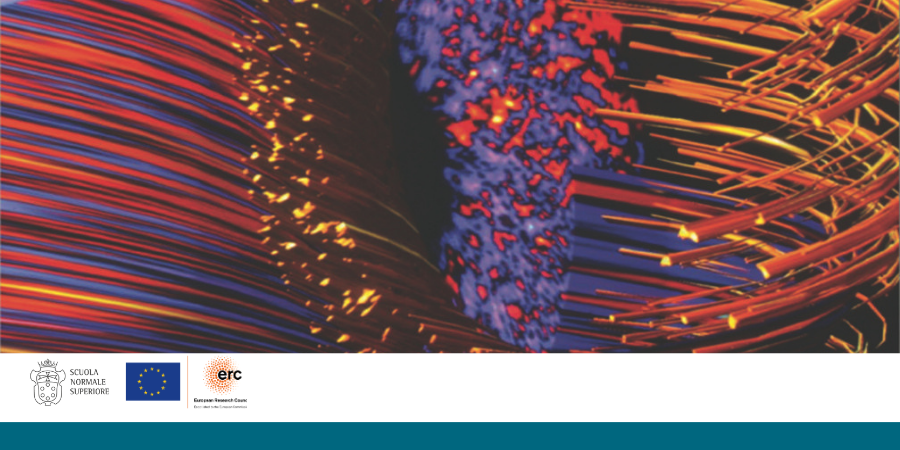
IMG: U.S. Department of Energy - Science - 389 050 002 - CC WIKIMEDIA COMMONS