
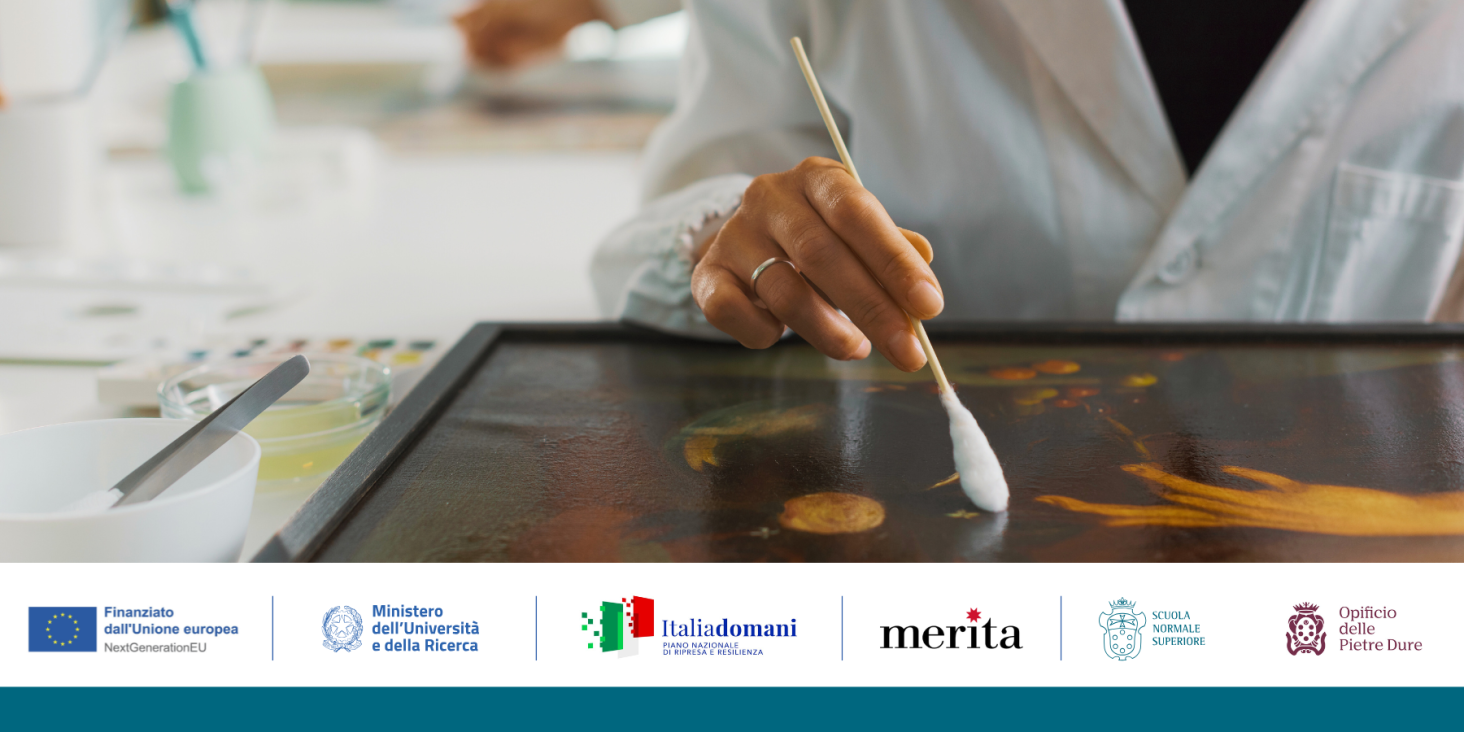
Diagnostics for Cultural Heritage: Research, Conservation, Accessibility
Organization
Organizing Secretariat

Organized by Scuola Normale Superiore in collaboration with the Opificio delle Pietre Dure, the school is funded by the PNRR through the MERITA, the network for talent project*.
Date: 12-15 May 2026
Location: SNS - Palazzo Strozzi, Opificio delle Pietre Dure
Total hours: 32
Max participants: 16
Language: English and Italian
Application deadline: 15 February 2026
Target audience: Undergraduates, Master's degree holders, PhDs, and recent graduates from both Humanistic and Scientific studies.
The workshop aims to introduce BA, MA, PhD students and recent graduates to theories and applications of Diagnostics for Cultural Heritage: an interdisciplinary growing field, not only for conservation and restoration, but also for research.
The workshop aims to present the most advanced diagnostic methodologies and techniques applied to the research and conservation of the architectural, archaeological, and historic-artistic heritage (stone, metals, ceramics, textiles, wooden objects, painted materials, etc.), focusing on the strategies, results and future perspectives.
The program includes a first part structured as a seminar session devoted to the presentation of different methodologies and case studies depending on lecturers’ research fields and experiences (Florence, Palazzo Strozzi), and a second part structured as a workshop session dedicated to the application and use of diagnostic tools (laboratory of the Opificio delle Pietre Dure).
Applicants must submit an application using the form no later than February 15, 2026 and attached an up-to-date signed Curriculum Vitae et Studiorum, including the exams’ list, and a short biographical note outlining the candidate research or study interests (max 600 words).
Each day is made up of 8 hours of lectures (from 9:00 am to 7:00 pm, with a lunch break of about 2 hours).
Participation in the workshop does not entail enrollment fees.
Admission to the course includes participation in the lectures, the educational material and lunch on the days when the course takes place.
The Scuola Normale Superiore provides participants with lodging in shared double hotel rooms for the duration of the workshop.
Keynote speakers:
Giulio Amara | Scuola Normale Superiore
Maria Cristina Caggiani | Università di Catania
Andrea Cagnini | Opificio delle Pietre Dure
Patrizia Capizzi | Università di Palermo
Cristina Chiavari | Università di Bologna
Francesca Coletti | Sapienza Università di Roma
Emanuela Daffra | Opificio delle Pietre Dure
Alessia Di Santi | Scuola Normale Superiore
Francesca Di Turo | Scuola Normale Superiore, Laboratorio NEST
Claudio Finocchiaro | Università di Catania
Monica Galeotti | Opificio delle Pietre Dure
Rodorico Giorgi | Università di Firenze
Francesco Grazzi | CNR - Istituto di Fisica Applicata “Nello Carrara”
Andrea Guerrini | Scuola Normale Superiore, Laboratorio NEST
Lorenzo Lazzarini | Università IUAV di Venezia
Giovanni Leucci | CNR - Istituto di Scienze del Patrimonio Culturale
Costanza Miliani | CNR - Istituto di Scienze del Patrimonio Culturale
Elisabetta Neri | CNR - Istituto di Scienze del Patrimonio Culturale
Roberta Occhipinti | Università di Catania
Simone Porcinai | Opificio delle Pietre Dure
Silvestro Antonio Ruffolo | Università della Calabria
Fabrizio Sudano | Museo Archeologico Nazionale di Reggio Calabria
Marco Verità | già Stazione Sperimentale del Vetro, Murano (Venezia)
____________________________________
* MERITA, the network for talent project is the result of a collaboration between five Italian academic institutions: the Scuola Normale Superiore, the Scuola Superiore Sant’Anna, the Collegio Superiore dell’Università di Bologna, the Scuola Galileiana di Studi Superiori dell’Università di Padova and the Scuola Superiore di Studi Avanzati della Sapienza Università di Roma.
The MERITA project is funded within the Piano Nazionale di Ripresa e Resilienza (PNRR), Missione 4 – Istruzione e Ricerca, Componente 1, Investimento 3.4 "Didattica e competenze universitarie avanzate"- "Rafforzamento delle Scuole universitarie superiori". (National Recovery and Resilience Plan (PNRR), Mission 4 – Education and Research, Component 1, Investment 3.4 "Advanced university teaching and competences" - "Enhancement of the institutions for higher education").
(IMG iStock | Credit Cyano66)