
How the World Made the West
Josephine Crawley Quinn I University of Cambridge
How the World Made the West - Seminario all’interno del corso della prof.ssa Corinne Bonnet
How the World Made the West attempted to debunk the myth of Western Civilisation as a self-made miracle. It argued instead that Greek, Roman, and other European roots are only one part of a bigger story of the emergence of what we now call the West through contact and exchange, journeys and relationships, trade and war from the invention of sailing on the Nile in the third millennium BCE to European sailors’ discovery of a larger world to their own west five hundred years ago. This isn’t news to Classicists of course: we know that the alphabet came from Egypt via Phoenicia, that modern numbers come from India via Arabic scholars world, and that democratic ideas and ideals may go back to ancient Assyria. We also know that the Greeks and Romans themselves understood this: they constantly talk about their own connections to and borrowings from others, and they consistently present their own history as the result of contact and exchange. But in the public imagination this entangled world has been lost to the nineteenth century notion of ‘civilizations’, the idea of distinct cultures associated with particular places that emerge, flourish, and then decline, and do so largely alone. In the book, prof. Crawley Quinn argues that this ‘civilizational thinking’ is fundamentally wrong. It isn’t peoples that make history, but people, and the connections they create with one another. Distinctive local cultures come and go, of course, but they are created and sustained by interaction.
Next Seminar:
Josephine Crawley Quinn I University of Cambridge
Anarchy in the Ancient Mediterranean - Lecture
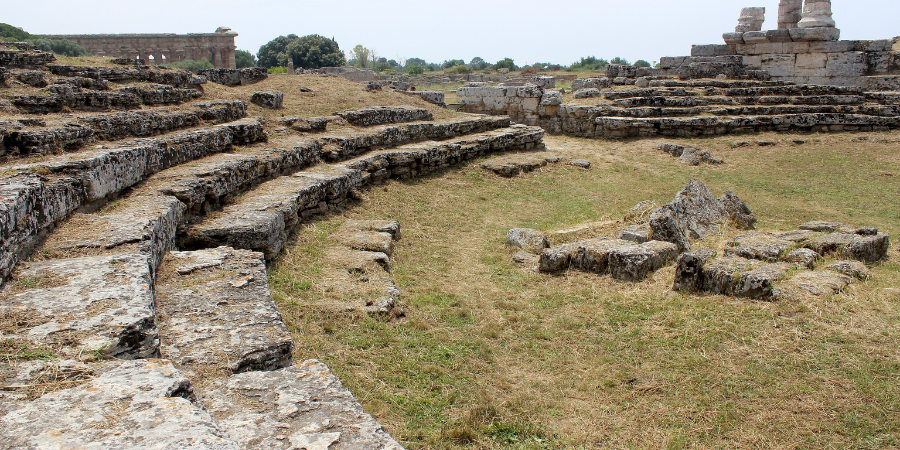
Rovine del Comitium di Paestum, foto di Miguel Hermoso Cuesta - CC WIKIMEDIA COMMONS